Olympic Pipeline partially reopens as Oregon gas prices edge up before busy holiday travel week, AAA says

PORTLAND, Ore. (KTVZ) – Gas prices remain relatively calm ahead of Thanksgiving, but the Oregon average has ticked up due to this month’s outage of the Olympic Pipeline in Washington state, AAA Oregon/Idaho reported Tuesday.
BP, the operator of the pipeline, announced Tuesday that the pipeline has been partially restarted.
This is one of the busiest travel weeks of the year, with AAA projecting record travel for Thanksgiving. Most travelers – nearly 90% – will go by car. For the week, the national average for regular slips two cents to $3.06 a gallon. The Oregon average adds three cents to $3.82 a gallon, while Bend's average rises about nine cents to $3.76 a gallon.
The Olympic Pipeline, the Pacific Northwest’s primary fuel artery, is partially open. The pipeline system consists of a 16-inch diameter pipeline and a 20-inch diameter pipeline. The system was shut down after a leak was detected near Everett, Washington on Nov. 11.
Response crews did 24-hour excavation operations in the area and have identified the source of the leak on the 20-inch pipeline. Repairs are being planned. BP says testing on the 16-inch pipeline found no indications of a leak and it was restarted early today.
The 400-mile pipeline system carries gasoline, diesel and jet fuel from refineries in Washington state to Portland. It also provides jet fuel to Sea-Tac International Airport.
Washington Governor Bob Ferguson and Oregon Governor Tina Kotek both declared emergencies due to potential disruptions in the delivery of fuel. The declarations waive certain regulations limiting the number of hours commercial vehicle operators can drive when transporting fuel.
“For now, impacts from the latest outage of the Olympic Pipeline appear to be minimal, as the Oregon average has only climbed about four cents since the outage occurred. With the pipeline partially open again, we expect pump prices in the region to soon resume their seasonal declines,” says Marie Dodds, public affairs director for AAA Oregon/Idaho.
An outage on the pipeline in September was one factor that caused gas prices in Oregon and Washington to soar. The outage occurred at the same time as planned and unplanned maintenance at refineries in Washington and California, and the switch to winter-blend fuel. These factors all put a crimp in supplies and sent gas prices significantly higher with the Oregon average jumping 32 cents.
AAA expects record travel for Thanksgiving 2025 with 81.8 million Americans (23.9% of the population) including about 1.17 million Oregonians heading over the river and through the woods for turkey and all the trimmings. This is a 2% increase over last year. Nearly 90% of travelers will drive, more than 7% will fly, and the rest will go by bus, train or take a cruise. Find all the details in the AAA Thanksgiving travel news release.
The Oregon average for regular gas began 2025 at $3.45 a gallon and is currently at $3.82. The highest price of the year so far is $4.297 on September 13 and 14. The lowest price of the year so far is just under $3.45 a gallon on January 2.
The national average began 2025 at $3.06 a gallon and is currently at $3.06. The highest price of the year so far is $3.268 on April 4. The lowest price of the year so far is $3.036 on October 19 and 20.
For those driving over the Thanksgiving holiday, the national average for regular gas is about one cent less than a year go. The Oregon average is about 27 cents more.
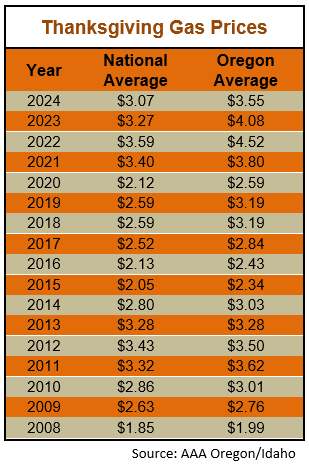
This week two Oregon counties have averages at or above $4, same as a week ago:
Multnomah $4.00
Wallowa $4.09
Demand for gasoline in the U.S. gasoline demand decreased from 9.03 million b/d to 8.53 million for the week ending November 14. This compares to 8.42 million b/d a year ago. Total domestic gasoline supply increased from 205.1 million barrels to 207.4 million. Gasoline production decreased last week, averaging 9.3 million barrels per day compared to 9.9 million barrels the previous week.
Gas prices usually drop in the fall, due to the switch from summer-blend to winter-blend fuel, which costs less to produce. The switch starts in September. Many areas, including Oregon, can sell winter-blend fuel starting September 15. However, Northern and Southern California require summer-blend fuel through October 31. Prices usually decline to their lowest levels of the year in late fall and early winter before increasing again in the late winter and early spring.
Gas prices typically rise starting in mid-to-late winter and early spring as refineries undergo maintenance ahead of the switch to summer-blend fuel, which is more expensive to produce and less likely to evaporate in warmer temperatures. The switch occurs first in California, which is why pump prices on the West Coast often rise before other parts of the country. The East Coast is the last major market to switch to summer-blend fuel. Most areas have a May 1 compliance date for refiners and terminals, while most gas stations have a June 1 deadline to switch to selling summer-blend until June 1. Switch-over dates are earlier in California with some areas in the state requiring summer-blend fuel by April 1. Some refineries will begin maintenance and the switchover in February.
