Oregon Gas Prices remain Quiet ahead of Labor Day; Refinery Issues send National Average Higher

Gas prices in Oregon and most other states are showing just small fluctuations as travelers gear up for Labor Day, the last holiday weekend of the summer. But issues at a major refinery in the Midwest are putting upward pressure on the national average.
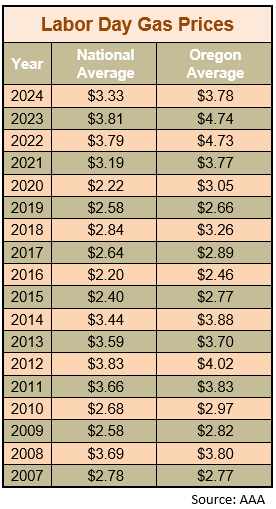
For the week, the national average for regular jumps six cents to $3.19 a gallon. The Oregon average holds steady at $3.98 a gallon.
Find details and graphics in the AAA gas prices news release below:

The BP refinery in Whiting, Indiana, which is the largest refinery in the Midwest and the largest inland refinery in the U.S., had to stop operations in several processing units last week after storms brought rain and flooding to the area. The outages caused pump prices in the region to spike. Some of the processing units have been restarted this week, so drivers in the region should get some relief at the pumps soon.
“As Oregonians get ready to travel for Labor Day, gas prices should remain calm here, as they’ve been all summer long. The steady crude oil prices this summer have translated into a mostly quiet summer at the pumps,” says Marie Dodds, public affairs director for AAA Oregon/Idaho. “The wildcard is hurricane season. With the peak of the season coming soon, there’s still the potential of a major storm that could impact production and distribution of oil and gas.”
Labor Day travel promises to be busy this year, capping off a record-setting summer for travel. AAA booking data shows that Alaska cruises, theme parks, Central Oregon and the Oregon Coast are the most popular destinations for members of AAA Oregon/Idaho. AAA says the good news for travelers is that flights, hotels and car rentals cost less this year compared to 2024. Find all the details, graphics, and advice for travelers in the AAA Labor Day travel news release.
The Oregon average for regular gas began 2025 at $3.45 a gallon and is currently at $3.98. The highest price of the year so far is $4.076 on June 24 and 25. The lowest price of the year so far is just under $3.45 a gallon on January 2.
The national average began 2025 at $3.06 a gallon and is currently at $3.19. The highest price of the year so far is $3.268 on April 4. The lowest price of the year so far is $3.06 on January 5.
This week 16 Oregon counties have averages at or above $4, compared to 18 a week ago:
Clackamas $4.06
Clatsop $4.15
Columbia $4.12
Curry $4.13
Grant $4.19
Harney $4.18
Jackson$4.02
Josephine $4.11
Lake $4.12
Multnomah $4.10
Sherman $4.02
Tillamook $4.19
Wallowa $4.23
Wasco $4.13
Washington $4.11
Yamhill $4.03
Demand for gasoline in the U.S. decreased from 9.0 million b/d to 8.84 million for the week ending August 15, according to the U.S. Energy Information Administration (EIA). This compares to 9.19 million b/d a year ago. Total domestic gasoline supply decreased from 226.3 million barrels to 223.6. Gasoline production decreased last week, averaging 9.6 million barrels per day compared to 9.81 the previous week.
Pump prices in most states will likely continue to see just small changes as the summer driving season comes to an end, if WTI crude oil prices remain below $70 per barrel and there are no supply disruptions or other unforeseen events.
Gas prices typically rise starting in mid-to-late winter and early spring as refineries undergo maintenance ahead of the switch to summer-blend fuel, which is more expensive to produce and less likely to evaporate in warmer temperatures. The switch occurs first in California, which is why pump prices on the West Coast often rise before other parts of the country. The East Coast is the last major market to switch to summer-blend fuel. Most areas have a May 1 compliance date for refiners and terminals, while most gas stations have a June 1 deadline to switch to selling summer-blend until June 1. Switch-over dates are earlier in California with some areas in the state requiring summer-blend fuel by April 1. Some refineries will begin maintenance and the switchover in February.
Gas prices usually drop in the fall, due to the switch from summer-blend to winter-blend fuel, which costs less to produce. The switch starts in September. Many areas, including Oregon, can sell winter-blend fuel starting September 15. However, Northern and Southern California require summer-blend fuel through October 31. Prices usually decline to their lowest levels of the year in late fall and early winter before increasing again in the late winter and early spring.
The U.S. price of crude oil (West Texas Intermediate) had been mostly in the low-$60s to mid-$70s since last September. Crude prices spiked to the mid-$70s in mid-June in response to the strikes between Israel and Iran, and then the U.S. strike on Iran’s nuclear facilities, but then prices fell back into the $60s on the belief that the conflict would not have a major impact on global oil supplies. Crude prices fell in early April as markets reacted to President Trumps tariffs and the impact on U.S. and global markets. Additional downward pressure on crude prices came after the decision by OPEC+ to increase production. The lowest closing price since September was $57.13 on May 5, which was the lowest closing price since February 2021. The recent high price for crude was $80.04 per barrel on January 15, which was the highest price since last August.
Crude oil is trading around $63 today compared to $62 a week ago and $77 a year ago. In 2024, West Texas Intermediate ranged between $66 and $87 per barrel. In 2023, WTI ranged between $63 and $95 per barrel. WTI reached recent highs of $123.70 on March 8, 2022, shortly after the Russian invasion of Ukraine, and $122.11 per barrel on June 8, 2022. The all-time high for WTI crude oil is $147.27 in July 2008.
Crude prices are impacted by economic news as well as geopolitical events around the world including the current economic uncertainty, unrest in the Middle East, the war between Israel and Hamas, and the war between Russia and Ukraine. Russia is a top global oil producer, behind the U.S. and Saudi Arabia. Crude prices have been volatile after the attack on Israel by Hamas in October 2023. While Israel and the Palestinian territory are not oil producers, concerns remain that the conflict could spread in the Middle East, which could potentially impact crude production in other oil-producing nations in the region. In addition, production cuts by OPEC+ in previous years tightened global crude oil supplies, which continued to impact prices. But this year, the cartel boosted production by 411,000 barrels per day in May and June, and July, 548,000 barrels per day in August, and another 547,000 barrels per day in September.
Crude oil is the main ingredient in gasoline and diesel, so pump prices are impacted by crude prices on the global markets. On average, about 52% of what we pay for in a gallon of gasoline is for the price of crude oil, 16% is refining, 16% distribution and marketing, and 16% are taxes, according to the U.S. Energy Information Administration.
Meanwhile, crude oil production in the U.S. remains near record highs. The U.S. Energy Information Administration (EIA) reports that crude production in his country rose from 13.33 to 13.38 million barrels per day for the week ending August 15. The record high is 13.63 million barrels per day for the week of December 6. Production has been at 13.5 million barrels per day many times since October. The U.S. has been the top producer of crude oil in the world since 2018 and has been increasing its oil production since about 2009.
Quick stats
Oregon is one of just 10 and the District of Columbia with lower prices now than a week ago. Ohio (+32 cents), Michigan (+25 cents), and Wisconsin (+21 cents) have the biggest week-over-week jumps in the nation, due to the outages at the outages at the major refinery in Indiana. Utah (-3 cents) has the largest week-over-week decline in the nation.
California ($4.57) has the most expensive gas in the nation for the fourth week in a row. Hawaii ($4.46) is second, and Washington ($4.40) is third. These are the three states with averages at or above $4 a gallon. This week 26 states and the District of Columbia have averages in the $3-range. There are 21 states with an average in the $2 range this week.
The cheapest gas in the nation is in Mississippi ($2.69) and Oklahoma ($2.70) and. No state has had an average below $2 a gallon since January 7, 2021, when Mississippi and Texas were below that threshold. At the time, the COVID-19 pandemic drove significant declines in crude oil and gasoline demand in the U.S. and around the world.
The difference between the most expensive and least expensive states is $1.88 this week, compared to $1.82 a week ago.
Oregon is one of 29 states and the District of Columbia with lower prices now than a month ago. The national average is four cents more and the Oregon average is one cent less than a month ago. Florida (-21 cents) has the largest month-over-month drop in the nation. Ohio (+18 cents) has the largest month-over-month increase.
Washington, Oregon, Ohio, and Alaska are the only states with higher prices now than a year ago. The national average is 16 cents less, while the Washington average is 22 cents more, the Oregon average is 17 cents more, the Ohio average is 13 cents more, and the Alaska average is four cents more than a year ago. North Dakota (-36 cents) has the largest yearly drop.
West Coast
The West Coast region continues to have the most expensive pump prices in the nation with all seven states in the top 10. It’s typical for the West Coast to have six or seven states in the top 10 as this region tends to consistently have fairly tight supplies, consuming about as much gasoline as is produced. In addition, this region is located relatively far from parts of the country where oil drilling, production and refining occurs, so transportation costs are higher. And environmental programs in this region add to the cost of production, storage and distribution.
| Rank | Region | Price on 8/26/2025 |
| 1 | California | $4.57 |
| 2 | Hawaii | $4.47 |
| 3 | Washington | $4.40 |
| 4 | Oregon | $3.98 |
| 5 | Nevada | $3.80 |
| 6 | Alaska | $3.76 |
| 7 | Illinois | $3.49 |
| 8 | Idaho | $3.49 |
| 9 | Arizona | $3.36 |
| 10 | Michigan | $3.35 |
As mentioned above, California has the most expensive gas in the nation for the fourth week in a row. Hawaii, Washington, Oregon, Nevada, and Alaska round out the top six. Arizona is ninth. Oregon is fourth most expensive for the 14th week in a row.
The refinery utilization rate on the West Coast edged up from 90.1% to 90.2% to for the week ending August 15. This rate has ranged between about 72% to 93% in the last year. The latest national refinery utilization rate ticked up from 96.4% to 96.6%.
The refinery utilization rate measures how much crude oil refineries are processing as a percentage of their maximum capacity. A low or declining rate can put upward pressure on pump prices, while a high or rising rate can put downward pressure on pump prices.
According to EIA’s latest weekly report, total gas stocks in the region increased from 31.61 million bbl. to 31.23 million bbl. An increase in gasoline stocks can put downward pressure on pump prices, while a decrease in gasoline stocks can put upward pressure on pump prices.
Oil market dynamics
Crude oil prices rose Monday of this week, as talks to end the war in Ukraine have stalled and Ukraine targeted Russian energy facilities. Crude prices retreated today after Russia said one of its largest refineries would start up again soon. Investors also believe that expectations of a potential cut in U.S. interest rates could lead to increased demand for oil.
Meanwhile, the EIA reports that crude oil inventories decreased by 6 million barrels from the previous week. At 420.7 million barrels, U.S. crude oil inventories are about 6% below the five-year average for this time of year.
At the close of Friday’s formal trading session, WTI added 14 cents to close at $63.66. At the close of Monday’s formal trading session, WTI gained $1.14 to settle at $64.80. Today crude is trading around $63 compared to $62 a week ago. Crude prices are about $14 less than a year ago. ($77.42 on August 26, 2024)
Drivers can find current gas prices along their route with the free AAA Mobile app for iPhone, iPad and Android. The app can also be used to map a route, find discounts, book a hotel and access AAA roadside assistance. Learn more at AAA.com/mobile.

Diesel
For the week, the national average remains at $3.70 a gallon. The record high is $5.816 set on June 19, 2022. The Oregon average holds steady at $4.47. The record high is $6.47 set on July 3, 2022. A year ago the national average for diesel was $3.70 and the Oregon average was $3.95.
Labor Day travel promises to be busy this year, capping off a record-setting summer for travel. AAA booking data shows that Alaska cruises, theme parks, Central Oregon and the Oregon Coast are the most popular destinations for members of AAA Oregon/Idaho. Find all the details, graphics, and advice for travelers in the AAA Labor Day travel news release.
