Scholars’ solution to centuries-old mystery of ‘Beeswax Wreck’ off Oregon coast can be read for free online

PORTLAND, Ore. (KTVZ) — For centuries, beeswax and Chinese porcelain have washed ashore on Nehalem Spit, on the north Oregon Coast.
After years of research in archives around the world, in combination with archaeological evidence, scholars were able to point to the Santo Cristo de Burgos, a seventeenth-century Manila galleon owned by the kingdom of Spain, as the mysterious vessel commonly known today as the “Beeswax Wreck.”
On June 16, National Geographic announced that state officials had confirmed the recovery of timbers from the Santo Cristo de Burgos near Manzanita.
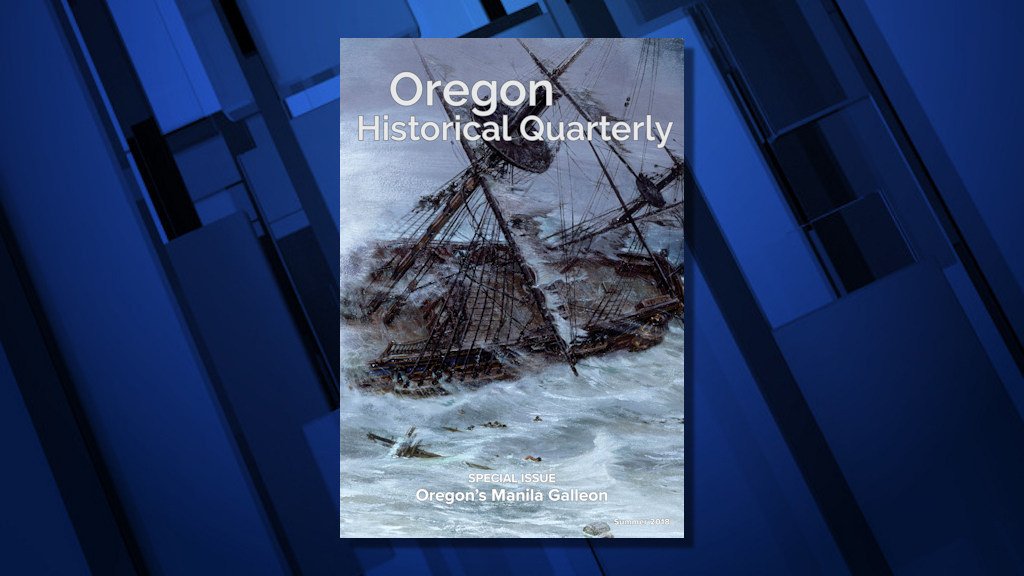
In the summer of 2018, the Oregon Historical Society’s scholarly journal, the Oregon Historical Quarterly, published a ground-breaking special issue on this research, a powerful combination of archaeological and archival evidence solving this centuries-old mystery. In light of the recent discovery of remains from the wreck, OHS has recently made this special issue of OHQ, “Oregon’s Manila Galleon,” available for free online.
“Our understanding of the history of the Beeswax Wreck is because of the knowledge and scholarship shared by dedicated individuals from across disciplines and centuries; everything from Native oral tradition to archival research to maritime archaeology has brought new information to the public about one of Oregon’s most fascinating mysteries,” said Oregon Historical Quarterly Editor Eliza E. Canty-Jones. “With this exciting discovery of timbers from the ship itself, OHS is proud to make this scholarship accessible to all to provide a more complete narrative of this fascinating piece of Oregon history.”
Stories of a very large shipwreck began circulating during the earliest days of Euro- American presence in the Pacific Northwest, as fur traders and explorers learned from Native people that a large ship had long ago wrecked on Nehalem Spit, with survivors and cargo that included beeswax. The stories, shrouded by speculation and often contradictory Euro-American folklore, captivated treasure-hunters who searched for a century and a half on nearby Neahkahnie Mountain and the adjacent beaches.
The archaeologist-led team of the Beeswax Wreck Project used geology, archaeology, and porcelain analysis, combined with documentation from Spanish archives, to pinpoint the ship’s likely identity. Beeswax stamped with Spanish shippers’ marks confirmed the wreck’s origin, and patterns on Chinese porcelain sherds allowed researchers to narrow the date range.
The Spanish Manila galleon trade was the first global network, and close to 300 galleons left the Philippines for Acapulco carrying Asian goods during its 250-year span. The Project determined that the Beeswax Wreck was one of two galleons that vanished without a trace: the Santo Cristo de Burgos, which sailed in 1693, or the San Francisco Xavier, which left Manila in 1705. Mapping the location of beeswax deposits allowed Project members to assert with confidence that the ship almost certainly wrecked before the 1700 Cascadia earthquake and tsunami.
Cameron La Follette and her team of archivists then undertook wide-ranging research in the archives of Spain, the Philippines, and Mexico to locate all available information about the Santo Cristo de Burgos of 1693. They discovered the history of the ship’s Captain, Don Bernardo Iñiguez del Bayo; a complete crew and passenger list; and highly important facts about the cargo.
Researchers now know that the Santo Cristo de Burgos — which was built at the Solsogón shipyard on Bagato Island in the Philippines — was carrying 2.5 tons of liquid mercury. Public reports at this time do not indicate whether mercury testing has been completed on the recovered timbers.
After many years of work to solve this multi-century mystery, La Follette’s research team and the Beeswax Wreck Project group published their findings in this special issue of the Oregon Historical Quarterly. La Follette is executive director of Oregon Coast Alliance and lead author on the special issue. By day, she advocates for coastal conservation, and by night she writes poetry, which is archived at the University of Oregon’s Special Collections and University Archives.
The Oregon Historical Quarterly (OHQ) is a peer-reviewed public history journal published by the Oregon Historical Society that brings history about Oregon and the Pacific Northwest to both scholars and general readers. OHQ is one of the largest state historical society journals in the United States and is a recognized and respected source for the history of the Pacific Northwest region.
The Summer 2018 issue of the Oregon Historical Quarterly is now available to read for free online, and print copies are also available for purchase in the Oregon Historical Society Museum Store for $10. A subscription to OHQ is a benefit of Oregon Historical Society membership.
About the Oregon Historical Society
For more than a century, the Oregon Historical Society has served as the state’s collective memory, preserving a vast collection of artifacts, photographs, maps, manuscript materials, books, films, and oral histories. Our research library, museum, digital platforms & website (www.ohs.org), educational programming, and historical journal make Oregon’s history open and accessible to all. We exist because history is powerful, and because a history as deep and rich as Oregon’s cannot be contained within a single story or point of view.
