How does outsourced accounting compare to hiring in-house staff?


The median annual wage for an auditor or accountant in the U.S. is $81,680. However, this doesn’t include office overhead, benefits, software, or the financial and time costs of finding the right candidate.
The gap between perceived and actual costs may shape whether you’re making a smart financial decision or an unexpectedly expensive one. The choice between in-house and outsourced accounting can significantly affect your budget, time, risk exposure and ability to scale.
This comprehensive guide from Marshall Jones walks you through the likely costs, time investment and additional essential factors that will influence your decision.
Key Takeaways
Explore the most crucial factors to keep in mind when comparing outsourced and in-house accounting:
- Salary is the starting point: While salary is an initial cost to consider, comprehensive compensation packages for in-house staff significantly increase overall employer expenses.
- Outsourced pricing varies by scope: Outsourced accounting pricing can hinge on reporting complexity, transaction volume, payroll needs and the range of services provided.
- The talent pool is shrinking: The accounting talent pool is shrinking, making it challenging to recruit qualified staff.
- CPA pipeline pressure continues: The pipeline of newly qualified CPAs remains constrained.
- Fraud risk is real for small businesses: Small businesses face substantial financial risks from occupational fraud.
- Survival requires sound financial management: Effective financial management is crucial for business survival and long-term resilience.
What Are the Differences Between Outsourced and In-House Accounting?
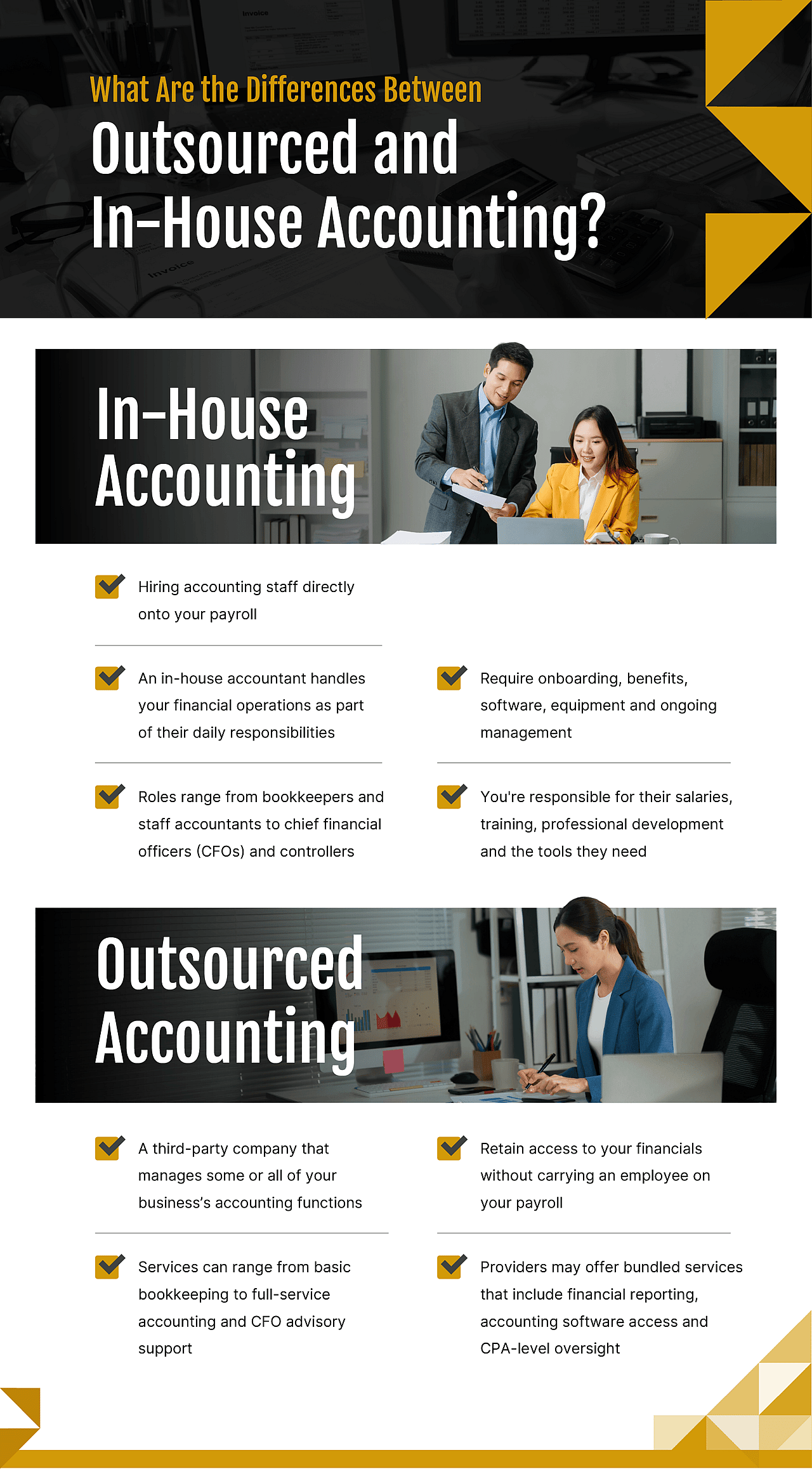
Employment structure is the main difference between the two models. In-house accounting relies on employees working within your business on your payroll. Outsourced accounting involves engaging an external provider under a service agreement. Both accounting models manage similar tasks, but they differ in cost structure, time dedication and access to expertise.
Understanding the differences between accounting and bookkeeping can also help you determine the support your organization can benefit from. Bookkeeping focuses on the minute details of your finances — reconciling accounts, keeping accurate records and recording transactions. However, accounting takes a big-picture, strategic view, interpreting financial data to guide business decisions.
What Is In-House Accounting?
In-house accounting means hiring accounting staff directly onto your payroll. An in-house accountant handles your financial operations as part of their daily responsibilities. Accounting roles range from bookkeepers and staff accountants to chief financial officers (CFOs) and controllers, representing higher levels of accounting leadership.
In-house accounting staff members require onboarding, benefits, software, equipment and ongoing management. You’re responsible for their salaries, training, professional development and the tools they need to carry out their duties.
What Is Outsourced Accounting?
Outsourced accounting engages a third-party company to manage some or all of your business’s accounting functions. Services can range from basic bookkeeping to full-service accounting and CFO advisory support.
Under a service agreement, you work with an external team rather than in an employment relationship. You retain access to your financials without carrying an employee on your payroll. Some outsourced providers may offer bundled services that include financial reporting, accounting software access and CPA-level oversight.
What Does In-House Accounting Really Cost Small Businesses?
The salary figure is only the start. Employer costs can rise considerably when you include extras like benefits and software. Small businesses must consider both direct and indirect costs, such as software licensing, workspace, equipment and management time. These small business accounting costs can add up quickly, especially when you factor in hiring, software and ongoing management.
Salaries, Benefits and Employer Overhead
According to the U.S. Bureau of Labor Statistics (BLS), employer-paid benefits can account for around 30% of employer compensation costs. Key cost layers include:
- Direct compensation: For estimating purposes, applying a 30% benefits load to a $70,000 salary would bring compensation costs to approximately $91,000 before overhead.
- Workspace and equipment: Add utilities, office space, computer equipment and the management time needed to support the accounting employee.
- Ongoing fixed costs: You carry the responsibility of salary, payroll taxes and benefits, regardless of how well your business is performing.
Accounting Software and Equipment Expenses
An in-house accounting employee needs a licensed accounting platform, and your company bears that cost directly. Businesses are typically responsible for purchasing and maintaining accounting software, payroll and reporting platforms, and other financial tools separately.
Outsourced accounting providers may offer bundled software access within their service agreements, removing a separate license cost. When comparing different accounting software platforms, check whether the software cost is included in an outsourced engagement or becomes an additional expense to you.
Recruitment and Training Costs
Finding, hiring and onboarding accounting staff involves both one-time and recurring costs. The pool of qualified accounting professionals is shrinking. In the 2023-2024 academic year, 55,152 students earned accounting degrees, a 6.6% decline from the previous year. In 2025, only 23,978 out of 87,660 CPA Exam candidates passed their final section, highlighting the narrowing pipeline of newly exam-qualified accounting talent.
When an in-house employee leaves, you incur visible costs, including job postings, interviews, recruiter fees and onboarding. The less visible costs include lost productivity, knowledge gaps and the time it takes for new hires to learn systems.
Beyond direct hiring costs, businesses should also factor in the time required to recruit, onboard, manage and cover accounting staff.
How Much Do Outsourced Accounting Services Cost?
Where in-house accounting carries layered costs, outsourced accounting operates on a predictable fee structure. Many providers bundle labor, software and oversight into one monthly fee. Pricing commonly reflects transaction volume, reporting frequency, payroll needs, advisory support and overall business complexity.
Common Pricing Structures for Outsourced Accounting
The two most common pricing models are hourly billing and flat monthly retainers. Hourly billing may suit businesses with project-based accounting needs, whereas flat monthly retainers provide predictable costs that simplify budgeting.
Key pricing drivers include service scope, transaction volume, number of accounts and reporting frequency. A business processing 50 transactions per month with basic bookkeeping needs will likely pay less than one processing 500 transactions with multi-entity reporting, payroll and tax planning.
What Is Included in an Outsourced Accounting Service?
Many outsourced accounting providers bundle multiple services into one engagement. A typical full-service package covers the core functions your business needs without requiring you to manage in-house staff. Common services can include:
- Monthly reconciliation: Your accounts are reconciled and balanced each month for accurate financial reporting.
- Financial statement preparation: You receive profit and loss statements, balance sheets and cash flow reports on a regular schedule.
- Managing accounts payable and receivable: The provider handles invoicing, collections, vendor payments and cash flow tracking.
- Payroll processing: Tax withholding, reporting and employee payroll are managed on your behalf.
- Tax preparation and planning: CPA-level professionals manage tax compliance and offer strategic tax planning guidance.
- Software access: Many outsourced accounting services for small businesses bundle accounting software into the engagement, removing the separate license cost.
- Continuous advisory support: You gain assistance with interpreting financial data and making informed business decisions throughout the year.
Outsourced accounting can also reduce the administrative time spent managing accounting staff. However, business owners still need to share financial information and collaborate on strategic decisions.
The responsibilities of a professional bookkeeping service include maintaining accurate records, reconciling your accounts, and ensuring your financials are ready for review by a CPA or board.
Factors to Consider When Choosing Between In-House and Outsourced Accounting
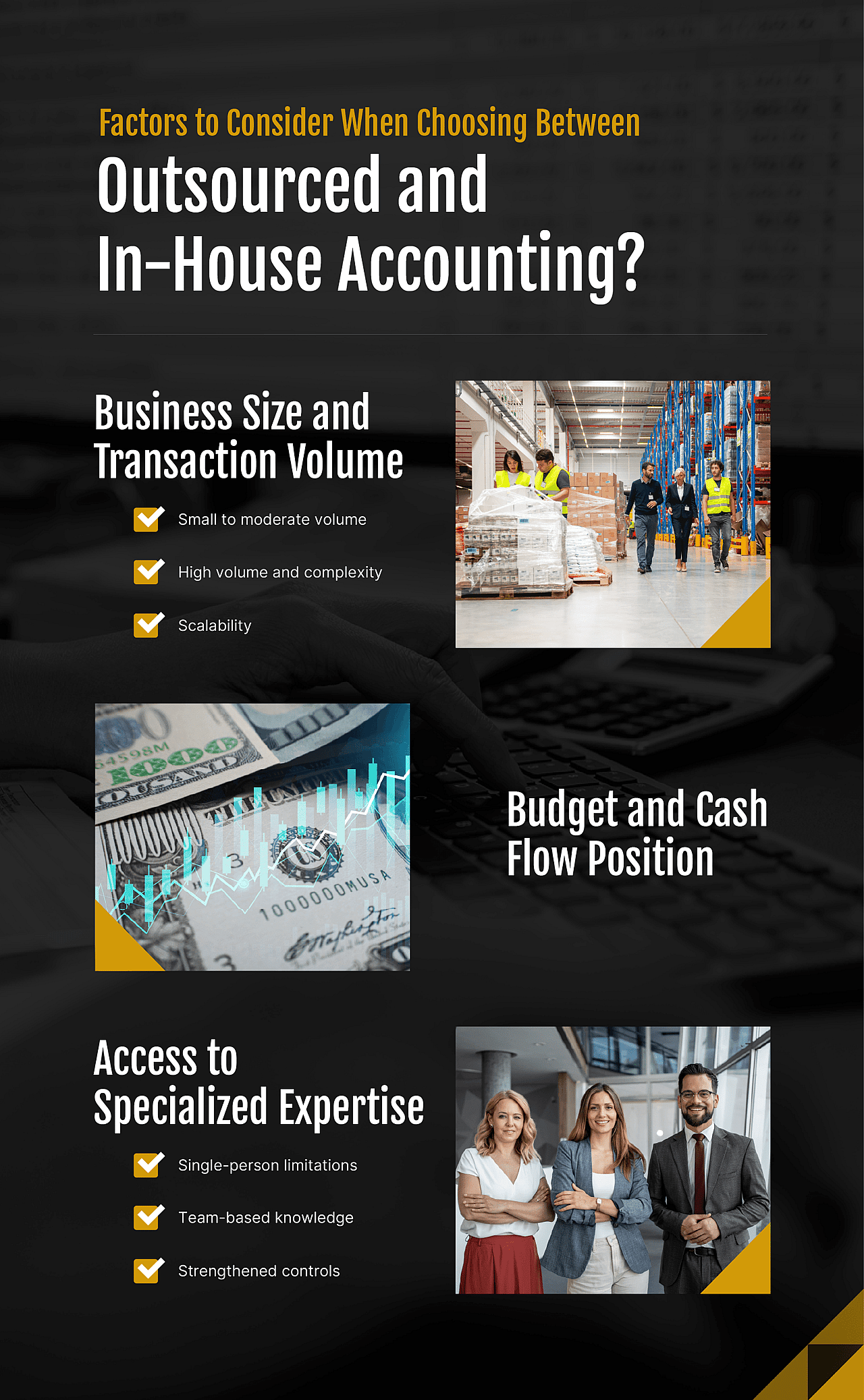
Each business has different transaction volumes, budget constraints, growth plans and internal resources. The factors below can help you evaluate which model aligns with your needs.
Business Size and Transaction Volume
Low to moderate transaction volume may not justify the full cost of an in-house hire. As transaction volume grows, the calculus can shift. Key considerations may include:
- Small to moderate volume: Businesses with 5-50 employees typically process fewer transactions and may find outsourced accounting more cost-effective than a full-time hire.
- High volume and complexity: Higher transaction volume, multi-entity structures and complex reporting could warrant a dedicated in-house accountant with specialized knowledge of your operations.
- Scalability: Providers scope outsourced accounting based on transaction volume and service requirements, allowing businesses to adjust support as their needs change. The accounting processes for growing businesses often require this kind of flexibility.
Budget and Cash Flow Position
In-house accounting is a fixed, high-overhead cost your business incurs regardless of revenue fluctuations. Outsourced accounting converts that fixed cost into a scalable monthly expense, which is meaningful for businesses managing tight or variable cash flow. Sound financial management plays a vital role in maintaining long-term resilience.
Access to Specialized Expertise
A small business that hires one bookkeeper or staff accountant gets access to one person’s knowledge base. The level of expertise available shapes the quality of your financial guidance.
Expertise considerations include:
- Single-person limitations: One in-house employee brings one skill set, which may not cover all your accounting needs. This may prove challenging if your business operates in an industry with specific compliance requirements.
- Team-based knowledge: An outsourced accounting firm brings a team of certified public accountants and advisors with experience across different industries and financial situations, giving you access to broader expertise without hiring multiple employees.
- Strengthened controls: Organizations with fewer than 100 employees experience a median occupational fraud loss of $141,000, according to a report from the Association of Certified Fraud Examiners. Broader distribution of responsibilities may strengthen internal controls by separating financial duties across multiple professionals.
Reviewing the basics of small business bookkeeping can help you determine the level of expertise your business requires.
In-House Accounting vs. Outsourced Accounting
Now that you know the costs, time demands and decision factors, here are the major trade-offs. Each model offers distinct advantages and challenges.
In-House Accounting Pros and Cons
In-house accounting offers immediate availability and direct oversight, but it comes with high costs and risks.
Pros include:
- Daily availability: In-house staff work within your business daily. Over time, they develop institutional knowledge of your operations and financial history.
- Direct control: You manage the employee directly and have full visibility into their priorities and decision-making process.
- Multiple roles: Depending on their skills and your business’s needs, an in-house employee may be able to handle tasks beyond accounting.
Cons include:
- High costs: Salary, benefits, overhead and software add up quickly, often exceeding initial budget expectations.
- Turnover risk: When your accountant leaves, institutional knowledge leaves with them.
- Coverage gaps: Vacations, sick days and departures leave your accounting department understaffed or unattended.
Outsourced Accounting Pros and Cons
Outsourced accounting can offer predictable costs and access to an experienced team, but it requires clear communication and data-sharing processes.
Pros include:
- Predictable costs: You pay for services, not salaries and benefits, and costs are bundled into a flat monthly fee that’s easier to budget and plan around.
- Scalable services: You can change service levels without adding internal headcount.
- Faster setup: Engaging an outsourced provider generally takes less time than recruiting and onboarding a new employee from scratch.
- Stronger controls: Distributing financial responsibilities across multiple professionals can strengthen internal controls. It can reduce the risk of errors or fraud that occur when a single person handles all financial functions.
Cons include:
- External operations: The provider works externally, which may feel less hands-on than having someone in your office daily.
- Data sharing: You need systems to regularly share financial information and documentation, like receipts and invoices, with the provider.
- Onboarding period: Transitioning to a new provider takes time to align on expectations and reporting formats during the initial setup phase.
- Less direct oversight: Some business owners may prefer to manage an employee directly rather than working with an external team.
Choosing the Right Accounting Model for Your Business
Neither in-house nor outsourced accounting is the right choice for everyone. The better fit depends on how much control you need, the complexity of your accounting requirements and whether your current budget can support the full cost of hiring internally.
For many small businesses, outsourced accounting offers a flexible way to access financial expertise without adding another employee. For larger organizations, an in-house team may provide the direct oversight and day-to-day availability they need. The right model should support your business today while giving you room to grow sustainably.
This story was produced by Marshall Jones and reviewed and distributed by Stacker.
