Keep getting texts about job offers? Don’t fall for this common scam

Celia Ong // Shutterstock
Scammers love to prey on hope, and with a 4.3 percent unemployment rate in the U.S. as of August 2025, they’ve got a lot of hopeful job seekers to pounce on. No matter the economic environment, though, job offer scams are a perennial favorite of sketchy grifters — the latest model just so happens to come in the form of a fake job text message, and it can seem rather convincing, too.
Got a text out of the blue about a potential job at your dream company? If it’s an opportunity that sounds too good to be true, that’s because it probably is. Spokeo explains how to know for sure.
Key Takeaways:
- Text-based job offer scams are on the rise.
- The latest job offer scams pose as recruiters or dream companies offering cushy jobs.
- They’re actually phishing scams out to get your valuable private information.
Job Text Scams: How They Work
The latest string of job offer scams has gotten so prevalent that the Federal Trade Commission issued a warning to help keep job hunters from getting their hearts broken and their bank accounts drained. The most recent popular iteration of the scam is a fake job text message from a phony “recruiter” or a dream job-worthy company. Here’s how it works:
- Victims get an unsolicited text, seemingly out of the blue.
- Said text claims to be from a job recruiting service, such as Indeed or ZipRecruiter, or from a popular company with dream job vibes (think Netflix or Apple) and often describes a cushy-sounding gig with a nice pay rate.
- The job description will be vague and suspiciously easy to fulfill. Slate describes a common example seeking “remote product testers” who only need to work for an hour or two a day to earn up to $400 daily by “reviewing new products or services online.” NPR, meanwhile, came across one that offered pay just for listening to songs on Spotify. Both are bogus.
- Once you apply, the scammers will let you know you’ve been “hired” (spoiler: everyone gets the “hired”), at which point they will ask for all sorts of sensitive private information (bank info, social security number, etc.).
- Alternatively, the link is just a phishing link, aimed at gathering your private information or installing malware onto your device.
What Do They Want?
Crooks aren’t sending out fake job text messages for fun. By and large, job offer scams are designed to obtain your valuable private information as a form of phishing. If you get lured in and respond to a job text scam, the scammer will most likely attempt to move you on to an “application” phase. Typically, this happens via a professional-looking online form, email, or an external chat app, like iMessage or WhatsApp. In order to “apply,” you’ll be prompted to provide sensitive, private information, which the grifter can then use to commit identity theft, most likely in an attempt to access your finances.
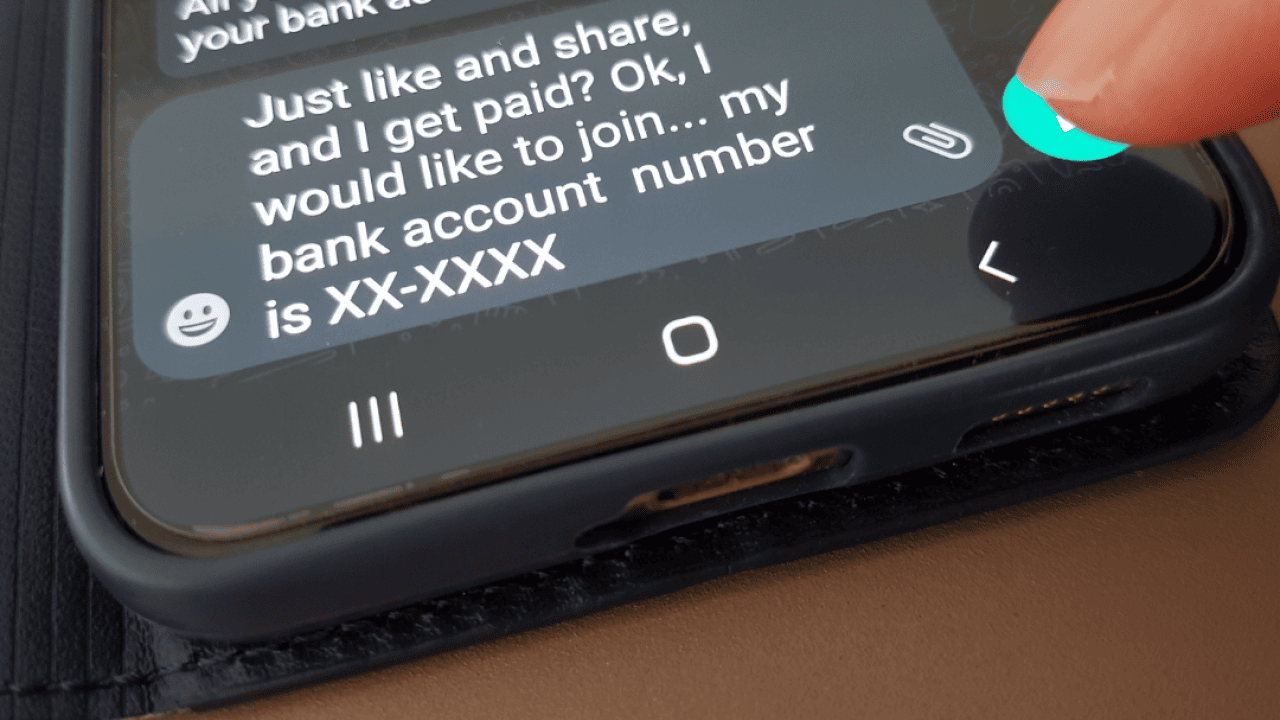
In some versions of job offer scams, the scammer will even offer to give you a portion of your future paycheck upfront, but to do so, they’ll need your bank account information. Of course, in the end, you’ll be the one paying them, against your will. In either case, your best bet is to avoid responding, period — block and report job text scams on sight.
How to Know If a Job is a Scam
When it comes to fake job text messages, the usual giveaways still apply. Things like typos, fishy-looking links or email domains (look for slight misspellings of real company or brand names, like “Inedeed” dot com instead of “Indeed” dot com), or “act now!” pressure tactics should make you give a very stern side-eye.
But on a level more specific to these text-based job offer scams from “recruiters,” keep your eyes peeled for these potential red flags:
- The job description sounds a little too easy, a little too well paid, or a little too good to be true.
- It’s a job you didn’t apply for or appears to be from a recruiter you haven’t used.
- The text is sent as part of a group chat, with multiple people gassing up the apparent company or job offer.
- The text directs you to external platforms like WhatsApp, iMessage, or WeChat.
- The texter has a non-U.S. country code. For instance, +91 is a message from India, while +63 is from the Philippines — both countries known for having high scam text activity.
- If an email address is given, the domain is a personal or free service, like “@gmail.com” or “@yahoo.com” instead of an official company domain.
- The recruiter is one you’ve never heard of, and a Google search for said “recruiter” comes up dry or produces accounts of previous scams.
- The sender asks for any sort of private information before you have an interview.
- You’re immediately “hired” without any form of a legitimate interviewing process.
Frequently Asked Questions About Job Scam Texts
Just like a real job interview, the much phonier world of job text scams elicits a lot of questions, and reasonably so. Here are some of the most common queries people search for when it comes to job offer scams.
Is it legal for your employer to text you?
Yes, though some states have proposed “right-to-disconnect” laws that could limit employer texts outside of business hours. However, the keyword here is “employer,” not random recruiters or job offers out of the ether.
Is it normal for jobs to text you?
While recruiting sites that you actually signed up for may send automated texts if you opted in to them, most legit employers do not send job offers via text — especially some of the bigger and shinier companies that job text scams like to name drop.
How do you report fake job offers?
When you block the number (and you should block the number), make sure to mark it as spam to help improve automatic spam detection for others across the board. You can also forward the text to 7726 (“SPAM”) or file a report at ReportFraud.ftc.gov.
This story was produced by Spokeo and reviewed and distributed by Stacker.

