California Couple Sentenced to Trafficking Lion Teeth, Tiger Pelt, and Rhino Horn

EUGENE, Ore. (KTVZ) -- Linh Luu and Kevin Le, a husband and wife from Anaheim, California, pleaded guilty Friday, October 23rd in federal court in Eugene, Oregon, to violating the Lacey Act for trafficking wildlife between Oregon and Vietnam.
A federal court sentenced both defendants to three years of probation and ordered each to pay a $10,000 fine for their roles in the illegal trade.
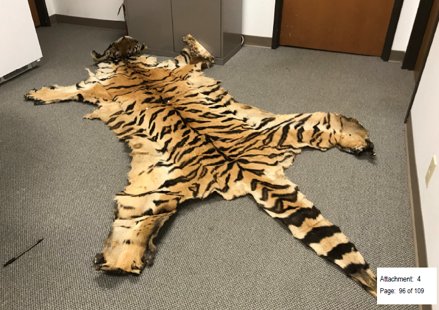
According to court records, Luu and Le admitted that between September 2019 and May 2021, they processed $51,100 in payments to help an individual in Vietnam move wildlife items illegally. The trafficked items shipped to Vietnam included American black bear gallbladders and cougar bones, while items imported into Oregon included lion teeth, segments of black and white rhinoceros horns and a tiger pelt.
Court documents detail an undercover meeting in December 2020 where Luu and Le met a federal agent in a parking lot. The couple accepted $12,000 in cash as a down payment for part of a rhino horn and discussed methods to avoid U.S. banking regulations. They later received nearly $5,000 each in electronic payments for the horn segment, which was shipped to Oregon disguised as a household decoration to establish trust for larger transactions.
Scott Bradford, U.S. Attorney for the District of Oregon, highlighted the role of financial facilitators in illegal wildlife networks. “Wildlife trafficking threatens some of the world's most vulnerable species and fuels criminal networks that profit from their destruction,” Bradford said. “This case demonstrates that our office will hold accountable not only the poachers, but also the financial facilitators who keep these markets alive. We are committed to working with our federal and state partners to disrupt these networks and protect endangered wildlife for future generations.”
Doug Ault, assistant director of the Office of Law Enforcement for the U.S. Fish and Wildlife Service, also commented on the financial mechanics driving illegal poaching. “This investigation clearly illustrates that wildlife trafficking isn't a victimless, white‑collar crime. It's the financial engine behind the slaughter of species like rhinos, tigers and black bears,” Ault said. “Every dollar laundered through wildlife trafficking networks represents real damage that cannot be undone. Poachers take the wildlife, but organizers and financial facilitators make the killing profitable and the Service and our law enforcement partners will continue pursuing everyone who builds and bankrolls these networks.”
All animal species involved in the case are protected under the Convention on International Trade in Endangered Species of Wild Fauna and Flora, an international treaty signed by the United States, Vietnam and 183 other governments to regulate trade in threatened species. Commercial trade in listed species requires a permit, which the defendants did not obtain. Black bears and cougars are native to Oregon and are used by some in traditional Asian medicine, while lions, tigers and black and white rhinoceroses are protected under the Endangered Species Act.
The investigation was led by the U.S. Fish and Wildlife Service's Office of Law Enforcement, with assistance from Homeland Security Investigations and the Oregon State Police. Assistant U.S. Attorney William McLaren and Senior Trial Attorney Ryan Connors of the Justice Department's Environmental Crimes Section prosecuted the case with support from Assistant U.S. Attorney Adam Nate.
