Tax increases to fund rural firefighting on ballots in quarter of Oregon counties

By Alex Baumhardt, Oregon Capital Chronicle
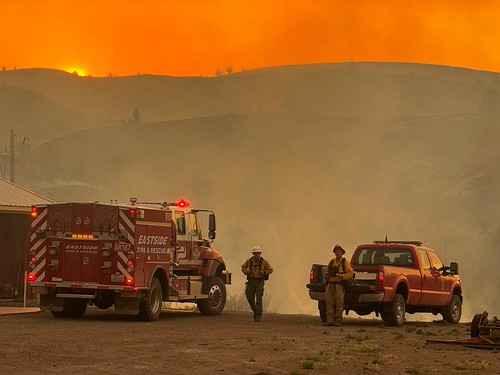
SALEM, Ore. - Voters in a quarter of Oregon’s 36 counties will vote in Tuesday’s election on whether to raise local property taxes to fund struggling fire districts and departments trying to keep up with rising costs and record acreage burned.
The tax levies and bonds for firefighting and emergency services are among more than 80 local ballot measures Oregonians in 27 counties will be asked to vote on by Nov. 3.
Others include raising local property taxes and bonding — essentially taking out a loan — to pay for school infrastructure, libraries and parks. In several counties and cities, voters will decide on new taxes for hotels and whether to ban marijuana or psilocybin sales. And one town of roughly 250 will decide on a 1-cent gas tax to fund local roads.
Fire
Getting local property tax payers to chip into firefighting budgets was on many ballots in the May primary and still more in the midterm. The state has experienced a succession of big wildfire seasons, including this year’s which burned a record 2.1 million acres.
There are 16 local measures on ballots to fund rural fire departments and districts in nine counties mostly in southern, eastern and central Oregon. Most are levies meant to cover annual operating expenses, and one would ask voters for permission to merge the Monitor and Mt. Angel Rural Fire Protection Districts and fund them collectively.
Property taxes fund the bulk of local fire departments and fire districts, but Measures 5 and 50 that passed in the 1990s essentially limited the growth of those taxes across the state by basing property values on a rate-limited assessment rather than market worth.
Other property tax suppressants, such as urban renewal districts and enterprise zones meant to incentivize development and job growth with low to no property taxes for a number of years, also siphon dollars from fire departments.
One of Umatilla County’s two fire districts — Umatilla County Fire District #1 — is asking voters for a tax levy that would send $13.9 million over five years to the department, despite large growth in the county property tax base from data centers in the last two decades.
Umatilla City Manager Dave Stockdale said the district has received a bit more than $100,000 a year since 2024 from enterprise zone revenues, but the department serves a small portion of the city and does not include much data center activity.
The other fire department — Umatilla Rural Fire Protection District — is planning a ballot measure in May 2027 to ask for tax increases for funding as well.
Kyle Sipe, president of the Umatilla County Rural Fire Protection District Board, said the agency has been asking for more money for years, and has been left out of community benefit agreement discussions that the city and county have had with data center developers.
Those are basically amounts the developers agree to pay for public schools, police,fire and other services in lieu of the taxes they are being saved from paying through enterprise zone and strategic investment agreements.
“They’re approving building four story apartments in our town now, and we don’t have a ladder truck that’s able to reach the tops of them,” Sipe said. “We can’t even afford to buy an AED (defibrillator) for one of our emergency vehicles right now.”
The fire department operates on about $950,000 per year, but costs will be over $1.1 million next year, he said.
Besides local property taxes, the city currently sends the district $89,000 a year from one strategic investment program deal with a data center company, and $250,000 per year from enterprise zone revenue the city collects and that goes into its general operating funds, according to City Manager Dave Stockdale. He said the city also sends $85,000 worth of in kind contributions to the district each year, such as a part-time administrative assistant.
Schools
Nine school districts are asking voters in November to approve school bonds for new infrastructure, including school security and safety measures, costing more than $1 billion combined. The districts include Gladstone, Glide, Grants Pass, Harney County, Hillsboro, North Clackamas, Reynolds, Silver Falls and Siuslaw.
In Harney County, where voters have not passed a new school bond in more than 20 years despite multiple campaigns by the school district, school officials are asking for $48.7 million to build a new K-8 school and upgrade its high school.
Drugs
Voters in six cities from eastern Oregon to the Coast will decide on measures to either add a tax to the sale, or prohibit the sale, of marijuana and psilocybin. If passed, Estacada and Sutherlin would ban the sale of marijuana, and Joseph, Redmond and Reedsport would ban psilocybin. The drug has been legal to use statewide in supervised sites since 2020, but cities and counties are allowed to opt out.
In Warrenton, voters will decide on a 3% sales tax on marijuana. The city had in 2014 adopted a 10% sales tax that is no longer allowed under Oregon law.
In 2015, the Legislature ruled that it was the body with the legal authority to set taxes on the drug, and that local jurisdictions could impose no more than a 3% tax of their own on marijuana.
Lodging and gas taxes
In Columbia and Coos counties, voters will decide on new taxes for hotels, Airbnbs and other short-term stays that could add hundreds of thousands of dollars a year to local budgets.
If approved, the transient lodging tax in Columbia County cities that already have a tax would go up by 4% and in unincorporated Columbia County a 13% tax on stays under 30 days would be imposed.
The county estimates the increases would raise up to $300,000 each year, helping to avoid more furloughs, staff cuts and the selling of assets to keep solvent.
In Bandon in Coos County, voters will decide whether to increase the city’s transient lodging tax from 9.5% to 12%.
In both counties, 50% of revenue would go to public services and the other 50% would support the local tourism industries.
In Rufus, a town of roughly 250 in north-central Oregon along the Columbia River and Interstate 84, city officials are also hoping to make some revenue gains off travelers.
Voters there will decide on a 1-cent-per-gallon gas tax to help pay for local roads and transportation infrastructure, a modest increase after voters overwhelmingly rejected the state’s attempted 6-cent gas tax increases per gallon earlier this year.
