Judge rejects defense motion to dismiss case against Smith Rock mass shooting plot suspect Samson Garner
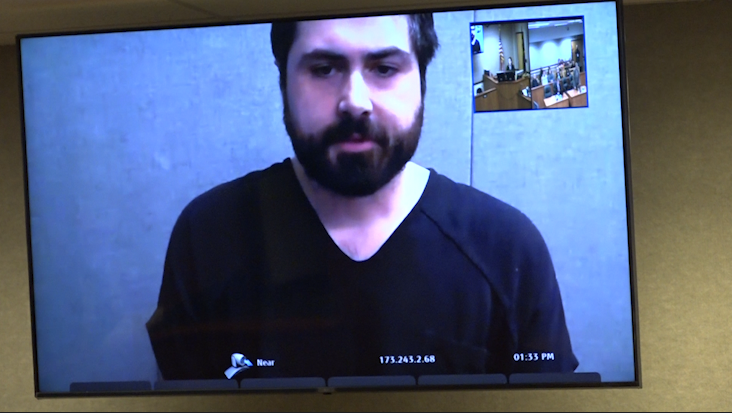

Won't order Deschutes DA's removal from case; arguments focus on privacy of subpoenaed medical records
BEND, Ore. (KTVZ) – A Deschutes County judge on Tuesday rejected a defense request to dismiss the case against Portland resident Samson Garner, accused of plotting a mass shooting last fall at a Smith Rock climbing event, or to remove the district attorney’s office from the case and appoint another prosecutor.
Legal arguments over defense motions continued Tuesday before Circuit Judge Allison Emerson in the case of Garner, scheduled to go on trial in late October, a year after his arrest and indictment on 26 charges, including attempted murder of multiple victims, attempted assault with a firearm and unlawful use of a weapon.
Chief Deputy District Attorney Mary Anderson and Deputy DA Stacy Neil represented the prosecution, while Garner, who turned 40 on May 6 and has been held on $10 million bail since his arrest last fall, sat beside defense attorney Joel Wirtz.
Prosecutors had filed a notice of “enhancement factors” in the case in December, which if a jury agrees could lead to a stiffer sentence upon conviction. But after the defense filed a motion, prosecutors presented the matter to a grand jury, which returned a finding of those enhancements last Friday.
The seven enhancement factors include “deliberate cruelty to victims” and the “intent to cause catastrophic physical and mental harm to the victims and witnesses.”
The grand jury also agreed that Garner allegedly chose a location and event (the Craggin’ Classic at Smith Rock State Park) “that maximizes harm to victims by preventing quick emergency medical and law enforcement response.”
Earlier this spring, Emerson rejected another defense motion to dismiss the indictment and a request to allow Garner’s conditional release pending trial, continuing the sizable bail amount.
Much of Tuesday’s arguments and judicial questions focused on a grand jury subpoena for Garner’s medical records dating back a year and whether that ran afoul of constitutional privacy protections. Wirtz argued medical records have “a much higher expectation of privacy” than records related to the defendant’s movement, which he said “we will litigate down the road in this case.”
Having reviewed case law, the judge rejected a defense argument that seeking medical records by subpoena is illegal. She said authorities “had the authority to issue a grand jury subpoena. I could not find any law that requires a grand jury subpoena to be regulated in some way.”
“The only question is, are there constitutional issues (regarding) privacy of medical records that would mandate this be limited in some way?”
Wirtz said, “No statute can be interpreted as granting the ability to subpoena, carte blanche, the medical records of a person.”
Neil noted that she and Anderson have not reviewed the medical records, but “they are in our computer system.”
Emerson said, “It is clear to me the state – the grand jury had the authority to issue the subpoena … the process was done as followed under Oregon Law.”
However, the issue she took under advisement is “whether or not a defendant has a privacy interest in the information that is obtained.”
“Based on my review of Oregon law, I have not found a case that is substantially similar,” the judge told the attorneys. “And so I think the question in this case is whether the defendant did have a constitutionally protected privacy right that would require law enforcement to get a warrant” from a judge, rather than the grand jury subpoena.
“I think this will be decided specifically on the facts of this case, based on the language of the subpoena and length of time” for which the records were sought, she said.
“Based upon those issues, I am not granting the motion to dismiss the indictment, or to appoint a separate prosecutor’s office” to handle the case, the judge ruled.
“So the only issue that will remain (on this motion) is whether or not there is an expectation of privacy in this case,” and the attorneys can make their arguments in filed briefings, Emerson said.
“This is ultimately how the court will decide whether or not this information is suppressed” at trial, the judge said.
Another trial readiness hearing in the case is scheduled for August 20, and a five-day hearing on nine motions is set to begin a week later. Among the standing defense motions is a request for a change of venue, which would move the trial elsewhere.
